
Understanding Apology Languages:
Insights for Meaningful Relationships

10 Heartfelt Sorry Love Letter Examples to Win Back Your Partner
10 Heartfelt Sorry Love Letter Examples to Win Back Your Partner with Sincere Apology Messages
Apologizing well can be the turning point that moves a relationship from defensiveness to repair, and a carefully written sorry love letter offers a chance to express regret, responsibility, and a clear plan for change. This article provides ten heartfelt sorry love letter examples to win back your partner alongside a research-informed framework for crafting apologies that feel genuine and actionable. Drawing insights from leading experts like Dr. Jennifer Thomas, a renowned researcher in the psychology of apologies, you will learn what makes a sincere apology effective, how to write one step-by-step, when to deliver it, practical personalization tactics for different issues and personalities, and the follow-up actions that convert words into renewed trust. Each example is labeled for common situations and includes quick modification notes so you can adapt language for him or her and for offenses from neglect to betrayal. Throughout, we integrate relationship psychology principles—like validation and accountability—so your apology does more than sound right: it helps rebuild connection. Read on to get the template, examples, tables mapping apology elements to sample lines, and clear lists of mistakes to avoid when saying your sorry to someone you love.
What Makes a Heartfelt Sorry Love Letter Effective for Winning Back Your Partner?
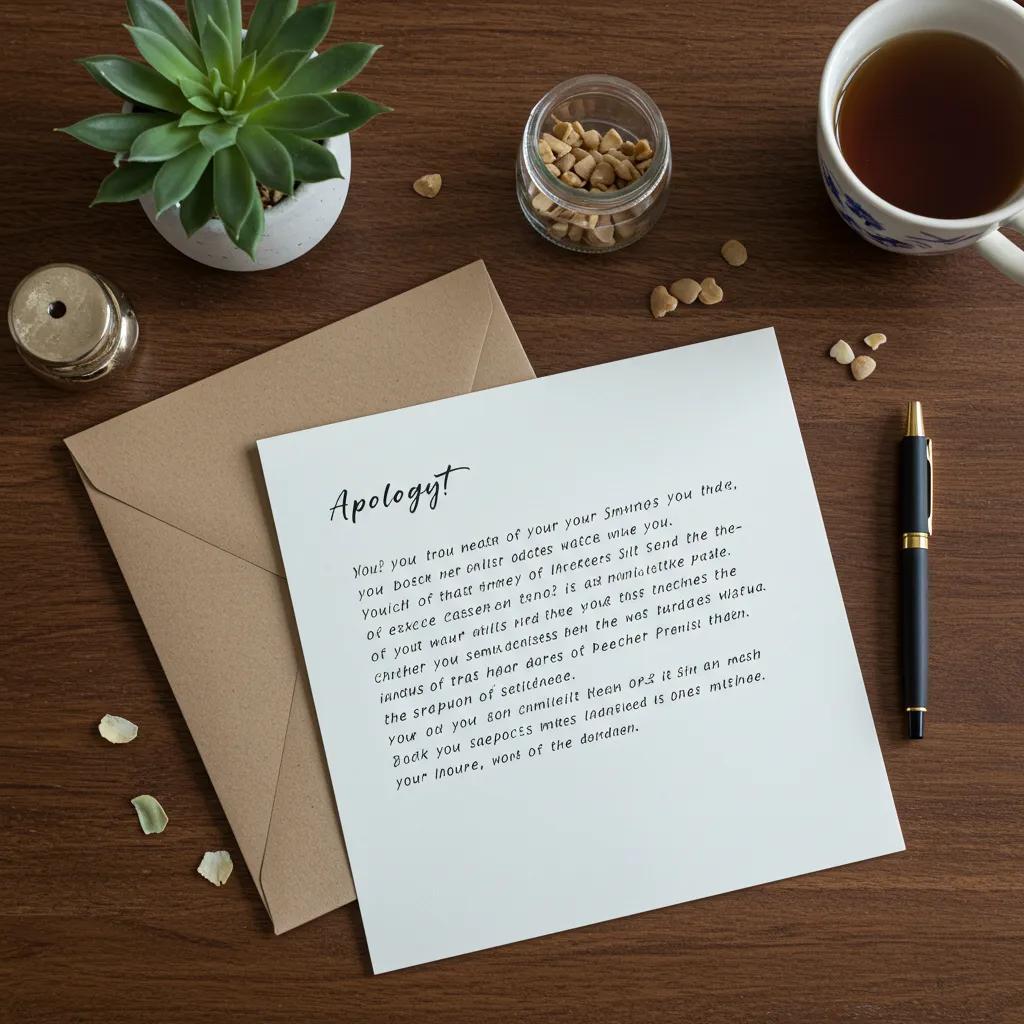
A heartfelt sorry love letter succeeds when it clearly acknowledges harm, takes responsibility, expresses remorse, validates the partner’s feelings, and offers a credible promise of change. These elements map directly to relationship repair mechanisms—acknowledgment reduces defensiveness, responsibility restores fairness, remorse signals empathy, validation rebuilds emotional safety, and commitment to change creates predictability. Understanding these components, often explored through frameworks like the 5 Apology Languages, helps you craft apology messages to my love that are sincere and tailored, increasing the chance of reconciliation. Below is a concise list of those key elements to target when writing your apology, followed by a practical table comparing each element to sample phrasing you can use. Understanding these components helps you craft apology messages to my love that are sincere and tailored, increasing the chance of reconciliation.
Acknowledgment of harm: Describe what happened and its impact.
Taking responsibility: Use “I” statements that own actions without excuses.
Expression of remorse: Convey genuine regret and emotional insight.
Validation of partner’s feelings: Recognize their pain as real and understandable.
Promise of change and reparations: Offer specific steps to prevent repetition.
This breakdown clarifies what to include in an apology and leads to concrete example lines you can adapt in your letter.
Apology ElementWhat It IncludesExample LineAcknowledgmentSpecific description of the action and impact"When I canceled our plans, I made you feel unimportant."ResponsibilityClear ownership using "I" without blaming"I was wrong to [action]; that was my choice and I own it."RemorseEmotional regret and empathy"I feel deep regret for hurting you and wish I could undo it."ValidationRecognize partner's feelings as valid"Your anger and sadness make total sense given what happened."Promise of ChangeConcrete actions and timeline"I'll call you every evening this week and share my schedule so you feel included."
What Are the Key Elements of a Sincere Apology Letter?
A sincere apology letter includes the essential elements described above, each expressed with clarity and without deflection. Start by naming the specific behavior and its effect, follow with an unqualified apology, explain what you learned, and close with a clear plan for change plus an invitation to respond. Effective sentences are short and specific—avoid vague generalities—so your partner can hear your intent rather than perceive justification. Including a brief reparative offer (time, action, or tangible steps) strengthens the letter’s credibility and helps the recipient see a path forward.
These building blocks transform a simple “I’m sorry” into a structured message that respects the partner’s perspective and demonstrates readiness to rebuild trust, which we will translate into step-by-step drafting guidance next.
How Does Expressing Genuine Remorse Help Rebuild Trust?
Expressing genuine remorse functions as an emotional bridge: it signals empathy, reduces the partner’s defensiveness, and opens space for forgiveness. Psychological research and clinical practice, including extensive work by experts such as Dr. Jennifer Thomas, indicate that remorse paired with tangible restitution increases reconciliation likelihood because it aligns emotional understanding with behavioral intentions. Genuine remorse avoids conditional language and focuses on the partner’s experience rather than on self-justification, using lines like "I understand how much this hurt you" instead of "I’m sorry if you were hurt." Demonstrating remorse honestly primes the partner to consider repair actions, and it naturally leads to presenting a plan for change that sustains the apology’s effect.
Understanding remorse’s role clarifies why the next section emphasizes precise wording and a stepwise method for writing your letter.
How Do You Write a Sincere Apology Letter to Your Partner?
Writing a sincere apology letter follows a clear sequence: reflect on the harm, acknowledge it explicitly, apologize without excuses, offer reparations, and commit to change with measurable actions. This sequence—reflect, acknowledge, apologize, repair, commit—creates a structure readers can follow to ensure every necessary element is present. Below is a numbered list of the main steps and a table that maps each step to sample lines you can personalize. Starting with reflection helps you avoid non-apologies and ensures your language matches the partner’s emotional experience.
Reflect on what happened and how it affected them before writing.
State the specific behavior and take responsibility with "I" statements.
Express clear remorse and validate their feelings without defensiveness.
Offer a concrete reparative action and timeline.
Close by inviting dialogue and outlining follow-up steps.
These steps produce an apology letter that reads as thoughtful and actionable, which we then convert into sample lines in the accompanying EAV table.
StepActionExample LineReflectConsider the partner's perspective"I’ve spent time thinking about how my actions affected you."AcknowledgeName the specific behavior"I missed our anniversary and that made you feel unseen."ApologizeUnconditional "I am sorry""I am truly sorry for hurting you."RepairOffer concrete reparation"I want to make it up by planning a dedicated weekend and covering the costs."CommitState measurable change"I’ll set a shared calendar and check in weekly for three months."
What Steps Should You Follow to Craft a Personalized Apology?
Begin by reflecting privately on the exact harm and its context, then draft a focused opening that names the incident and your role. Use precise sentences—avoid paragraphs that rationalize—and include a single concrete reparative action to avoid overwhelming the reader. Tailor tone and length to your partner’s communication style: concise and direct for reserved partners, more expansive and emotionally descriptive for expressive partners. Finish with an invitation to respond and a specific follow-up plan to demonstrate accountability; this helps convert the apology into an ongoing behavior change.
These practical steps ensure your apology is personal and actionable, paving the way to consider when you should actually send the letter.
When Is the Best Time to Send an Apology Letter?
Timing matters: send your apology when emotions have calmed enough for the partner to receive it, but not so long that the hurt festers without acknowledgment. A good rule of thumb is to wait until both parties are not in acute escalation—often after 24–72 hours—but exceptions exist if immediate safety or urgent clarification is needed. Choose the delivery method that fits the situation: handwritten for significant breaches, a thoughtful text for low-to-moderate hurts, and in-person for complex or high-stakes violations. Consider asking permission to send the letter when unsure, such as saying, "I have something important I want to say—may I share it?" which respects boundaries and improves receptivity.
Appropriate timing enhances the letter’s effectiveness and leads naturally into the concrete letter examples provided next.
What Are 10 Heartfelt Sorry Love Letter Examples to Win Back Your Partner?
Below are ten concise, adaptable sorry love letter examples covering common scenarios to win back your partner—organized for him and for her, with modification notes to personalize tone and content. Each example is short, emotionally direct, and includes a quick note on how to adapt wording for your partner’s personality or the specific offense. Use these as templates to create apology messages to my love that feel authentic and tailored.
Example grouping: 5 for him, 5 for her across issues like arguments, neglect, broken promises, forgetting important dates, and infidelity.
Each sample contains an opening acknowledgment, remorse, reparative offer, and a closing invitation to dialogue.
Personalization notes follow each sample to adjust tone and specificity.
These examples give you ready-made language to start from and help you see how the earlier principles map into complete letters, which follow in the H3 subsections.
What Are Apology Letter Examples for Him?
For an argument: "I’m sorry I raised my voice and cut you off. I realize I dismissed your feelings and left you feeling unheard. I want to listen and understand—can we carve out time tonight so I can hear you fully? I’ll turn my phone off and focus on you."Mod note: Keep language direct; avoid over-explaining.
For neglect: "I’ve been absent lately and that’s on me. I know my focus on work made you feel secondary, and I regret that deeply. I want to start by blocking out Wednesday evenings for us and checking in each morning. Will you let me try to earn back your trust?"Mod note: Offer concrete schedule changes he can verify.
For a broken promise: "When I didn’t follow through, I broke your trust and I’m sorry. I value our agreement and will make it right by doing X this week and sharing progress weekly. I know words mean little without action; I’m committed to proving it."Mod note: Specify the promised action and a realistic timeframe.
What Are Apology Letter Examples for Her?
For hurtful words: "I said things I regret and I’m truly sorry for the pain I caused. Your feelings mattered then and matter now, and I failed to show that. I will attend anger-management coaching and practice pausing before speaking; I’ll share what I learn with you."Mod note: Emphasize emotional validation and steps to prevent recurrence.
For forgetting an important date: "I’m ashamed I forgot our anniversary and the hurt that caused. You deserved better and I am sorry. I’ve planned a weekend to celebrate you and to show commitment to remembering what matters. I hope you’ll let me make amends."Mod note: Pair an apology with a thoughtful, not extravagant, reparative gesture.
For betrayal or infidelity (concise, honest): "I betrayed your trust and I am deeply sorry. There is no excuse. I will be transparent about my actions, accept consequences, and attend counseling if you want. I understand if you need space, and I’ll respect your pace."Mod note: Keep language humble, avoid minimization, and outline support options.
How Can You Personalize Sorry Messages to Match Your Partner’s Feelings and Relationship Situation?

Personalization requires aligning tone, length, and reparative actions with your partner’s personality and the severity of the offense. Just as understanding The 5 Love Languages helps partners express affection, recognizing your partner's preferred apology style is crucial for effective repair. Reserved partners typically respond to concise, accountable messaging that focuses on actions and timelines, while expressive partners often need more emotional language, acknowledgment of feelings, and relational context. Map the offense category—argument, neglect, mistake, betrayal—to an appropriate combination of validation, repair, and timeline to make your apology resonate. Below is a short decision checklist you can use when adapting any base letter, followed by examples of phrase swaps.
Identify partner style: reserved, expressive, anxious, or avoidant.
Match tone: brief and pragmatic for reserved; empathetic and descriptive for expressive.
Choose reparations: schedule changes for neglect, transparency steps for betrayal, or concrete restitution for broken promises.
Use this checklist to guide specific phrase choices and to ensure your apology reads as sincere rather than formulaic, which the next subsection expands on with issue-specific adaptation rules.
How Do You Adapt Apology Letters for Different Relationship Issues?
For arguments, focus on listening and neutral language—offer to meet and listen without defending. For neglect, propose schedule changes and small consistent actions to demonstrate renewed prioritization. For mistakes or forgetfulness, pair a sincere apology with a concrete restitution and a follow-up plan. For betrayal, combine full transparency, acceptance of consequences, and professional support options (e.g., therapy) as appropriate. Swap single sentences rather than rewriting the entire letter to maintain authenticity; for example, replace "I’m sorry I yelled" with "I’m sorry I made you feel dismissed when I raised my voice" to better validate emotion.
These adaptations help your message address both the wound and the relational repair—leading into tone selection guidance next.
What Tone and Words Resonate Best with Your Partner’s Emotional State?
When a partner is hurt and angry, use concise responsibility statements and offer space for cooling off, using phrases like "I understand why you’re angry" and avoiding "if" qualifiers. If they are withdrawn, gentle invitations to talk that respect autonomy work better—e.g., "I’m here when you’re ready." For anxious partners, include consistent small check-ins and reassurance lines such as "I will update you each day this week." Avoid defensive words like "but" or conditional apologies like "I’m sorry you feel that way." Tailoring tone and word choice this way increases the chance your apology is received as genuine and opens the door to reconciliation.
Choosing the right tone completes the personalization process and ushers in essential post-apology actions to rebuild trust.
What Actions Should Follow Your Sorry Love Letter to Rebuild Trust and Reconcile?
Words alone rarely rebuild trust; consistent, observable behaviors sustain forgiveness and repair. After sending a sorry love letter, follow up with transparent habits, measurable commitments, and opportunities for accountability. Actions can include scheduled check-ins, shared calendars, therapy or coaching, and specific reparative gestures that address the original harm. Below is a table mapping actions to their purpose and suggested timeframes, followed by lists of behaviors that demonstrate sincerity and ways to strengthen the relationship over time.
Consistent behavior demonstrates that your apology was not performative and helps the partner calibrate trust based on repeated experience rather than promises.
ActionPurposeSuggested TimeframeDaily check-insRebuild connection and predictability2–6 weeks, then reassessShared calendar/schedulePrevent neglect and increase transparencyImmediate and ongoingTherapy or counselingAddress deeper patterns and communicationStart within 1 monthSmall reparative gesturesShow attention to partner's needsWeekly for 1–3 monthsAccountability logsTrack progress on commitmentsWeekly for 8–12 weeks
How Does Changed Behavior Demonstrate Sincerity After an Apology?
Changed behavior is the proof that words promised; it converts verbal commitments into predictable reality and slowly rebuilds trust through repeated evidence. Specific behaviors—like consistent check-ins, transparent calendars, and following through on reparative actions—reduce uncertainty and allow the partner to observe progress over weeks and months. Establish measurable indicators (e.g., three weekly check-ins for six weeks) to make change visible and discuss progress in regular check-ins. Demonstrating behavioral change also reduces the likelihood of repeating patterns and shows respect for the partner’s emotional safety, which strengthens the foundation for reconciliation.
Behavioral follow-through naturally leads to long-term practices that maintain relationship health, discussed next.
What Are Effective Ways to Strengthen Your Relationship Post-Apology?
Ongoing practices that strengthen relationships include weekly check-ins to surface small issues before they escalate, shared routines that rebuild connection, and periodic reviews of commitments made after the apology. Activities like scheduled date nights, transparent calendars, and couples therapy when patterns are entrenched support sustained repair. Escalate to professional support if trust remains fragile or patterns of harm persist despite personal changes; therapy provides neutral structure and evidence-based tools for rebuilding safety. Regular, predictable actions combined with open dialogue help turn a single apology into lasting relational growth.
These post-apology strategies close the loop between apology and lasting repair and lead into the final section that highlights common errors to avoid.
What Common Mistakes Should You Avoid When Writing Sorry Love Letters?
Many apologies fail because they unintentionally invalidate the partner, minimize harm, or prioritize the apologizer’s comfort over repair. Common pitfalls, as highlighted by apology experts like Dr. Jennifer Thomas, include conditional apologies, deflecting blame, offering premature justifications, or making promises you cannot keep. Avoid phrases like "I’m sorry you feel that way," "If I hurt you," or "I did it because..." which shift focus away from the partner’s experience. Below is a clear list of mistakes and better alternatives, plus a short checklist to self-audit your letter before sending.
Mistake: Using conditional language that shifts blame.
Mistake: Offering excuses or justifications.
Mistake: Overpromising without a realistic plan.
Mistake: Skipping validation of the partner’s feelings.
These common errors undermine reconciliation and the next subsection explains why non-apologies are especially harmful to relationship repair.
Why Are Non-Apologies Harmful to Relationship Repair?
Non-apologies—statements that sound like apologies but avoid ownership—invalidate the partner’s experience and often escalate conflict by signaling insincerity. Examples like "I’m sorry you’re upset" or "I’m sorry if I hurt you" prioritize the apologizer’s perspective and can be experienced as dismissive. Psychologically, such phrases prevent empathy and repair because they do not acknowledge wrongdoing or the partner’s feelings, leaving the emotional wound unaddressed. Recognizing and avoiding non-apologies helps preserve credibility and creates the conditions necessary for genuine reconciliation.
The challenges of written communication, especially in love letters, can exacerbate these issues, as the absence of non-verbal cues and immediate feedback makes misunderstandings more likely.
Communication in Love Letters: Addressing Failures and Errors
How do people build a relationship when communicating via love letters? Communicative failures, mistakes, and errors can occur in any relationship. Written communication is more at risk of failures, mistakes, and errors than face-to-face communication because it lacks the nonverbal information of face-to-face interaction and the opportunity available in face-to-face interaction for immediate clarifying exchanges about potential or actual failures, mistakes, and errors. What goes on in love letter exchanges to shelter the couple relationship from the challenges inherent in communicating, particularly in written communicating?
Communication about communication in love letters: Addressing and avoiding failures, mistakes, and errors in written communication, PC Rosenblatt, 2020
While this guide focuses on romantic relationships, the principles of sincere apologies extend to all areas of life. For insights into repairing professional relationships, consider resources on workplace apologies, including Dr. Jennifer Thomas's book, Making Things Right at Work.
How Can You Ensure Your Apology Is Received as Genuine and Heartfelt?
Use a concise self-audit checklist before sending: acknowledge the action, take responsibility, express remorse, validate feelings, and propose concrete change and a repair step. Replace conditional phrases with direct ownership, keep reparations realistic, and invite dialogue rather than demand forgiveness. Close with an open line such as "I’m ready to listen when you are" to encourage response without pressuring the partner. Applying this checklist increases the likelihood that your apology will be perceived as genuine, laying the groundwork for ongoing trust repair and meaningful reconciliation.